Your dog has destroyed a cushion, excavated your garden, and barked at the same patch of wall for 20 minutes. You've walked them twice. You've played fetch until your arm ached. And they're still restless.
The problem isn't exercise. It's enrichment.
Physical exercise tires a dog's body. Mental enrichment tires their brain. And for most dogs — particularly intelligent breeds — a tired brain produces a dramatically calmer, more settled animal than a tired body alone. A 15-minute snuffle mat session can produce the same mental fatigue as a 45-minute walk.
Here are the most effective dog enrichment ideas that actually work in practice, not just in theory — ranked from easiest to implement to most involved.
What Is Dog Enrichment and Why Does It Matter?
Enrichment refers to any activity that engages your dog's natural instincts — sniffing, foraging, problem-solving, chewing, licking, hunting, or social bonding. These are the behaviours dogs evolved to perform for 6–8 hours a day in the wild. In a domestic environment, most of that instinctual drive goes unmet.
The result is what behaviourists call "frustration behaviour" — chewing, digging, excessive barking, pacing, destructive behaviour, and anxiety. These aren't personality flaws. They're symptoms of under-stimulation. A dog whose instincts are properly engaged through enrichment is a fundamentally different animal: calmer, more confident, less reactive, and easier to live with.
Enrichment also has documented neurological benefits. Problem-solving activities increase dopamine production. Foraging activities reduce cortisol. Licking and chewing release endorphins. Enrichment isn't a nice extra — it's a health requirement.
1. Snuffle Mat Feeding
A snuffle mat is a fabric mat with dense folds, loops, and pockets designed to hide kibble. Instead of eating from a bowl in 15 seconds, your dog has to use their nose to hunt through the mat, sniffing out individual pieces of food hidden throughout.
This activates the olfactory system more intensely than almost any other domestic activity. Dogs have up to 300 million scent receptors (compared to about 6 million in humans), and using that system deeply is genuinely exhausting for them in the best way.
What to do: Scatter your dog's regular kibble through the snuffle mat before every meal. Let them work through it. A meal that takes 10 seconds from a bowl takes 10–20 minutes from a snuffle mat. No additional training, no treats, no effort beyond the scatter.
Best for: All dogs, especially high-energy breeds, anxious dogs, dogs that eat too fast, and dogs that seem perpetually unsatisfied after meals.
2. Frozen Lick Mats
A silicone lick mat spread with peanut butter, yogurt, or wet food provides 5–15 minutes of calm, focused enrichment. Freeze the same lick mat overnight and that session extends to 30–45 minutes.
The repetitive licking motion is uniquely calming because it activates the parasympathetic nervous system — the "rest and digest" state — and triggers endorphin release. It is neurologically impossible for a dog to panic and lick simultaneously. This makes frozen lick mats particularly valuable for anxious dogs, bath time, thunderstorms, vet visits, and any situation where you need your dog calm and occupied.
What to do: Spread peanut butter (no xylitol), plain Greek yogurt, or mashed banana into the mat. Freeze flat for at least 2 hours. Give directly from the freezer. Keep 3–4 pre-loaded mats in the freezer at all times so you always have one ready.
Best for: Anxious dogs, bath time, nail trims, thunderstorms, post-surgery recovery, separation anxiety, hot summer days.
3. Puzzle Feeders
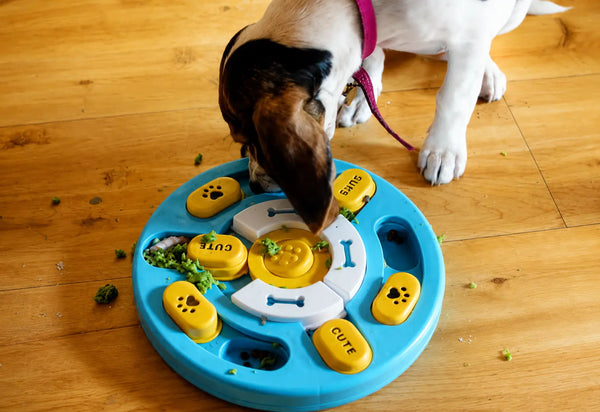
A puzzle feeder goes beyond a slow feeder bowl by requiring active problem-solving. Rotating compartments, sliding covers, and hidden sections force your dog to figure out the mechanism before accessing their food.
This engages the prefrontal cortex — the part of the brain responsible for executive function and problem-solving. High-intelligence breeds (Border Collies, Labradors, Golden Retrievers, Huskies, Poodles) particularly benefit from puzzle feeders because their brains are neurologically similar to those of human toddlers and require the same level of cognitive challenge to stay balanced.
Start with a beginner-level puzzle and move to intermediate or advanced as your dog masters each level. Dogs that solve puzzles too quickly without being challenged aren't getting the full benefit.
What to do: Replace one regular meal per day with a puzzle feeder session. Fill the compartments with your dog's regular kibble. Let them work through it unsupervised. Most dogs take 10–20 minutes on an appropriately difficult puzzle.
Best for: High-intelligence breeds, destructive dogs, dogs that seem bored even after exercise, dogs that get anxious when left alone.
4. Scatter Feeding
Scatter feeding is the simplest enrichment activity possible: instead of putting your dog's meal in a bowl, scatter it across the grass in your garden or across a textured mat indoors. Your dog has to use their nose to find every piece.
No equipment required. Zero cost. Enormous benefit. A meal scattered across a medium-sized lawn takes an average dog 15–25 minutes to fully find. They will be noticeably calmer afterward.
What to do: Take your dog's regular meal and scatter it across the grass. For indoor scatter feeding, use a snuffle mat or scatter across a fluffy bath mat. Supervise initially to make sure they're finding all the food.
Best for: Any dog. Particularly effective for dogs recovering from injury who need mental stimulation without physical exertion.
5. Cardboard Box Foraging
This is one of the most underrated free enrichment activities available. Take a cardboard box, fill it with screwed-up newspaper, and hide small handfuls of kibble or treats throughout the paper. Your dog has to tear through the paper and dig through the box to find the food.
This satisfies foraging, digging, and chewing instincts simultaneously. Most dogs find it enormously satisfying. It's also free, requires no special equipment, and can be made progressively harder by adding more paper layers or nesting smaller boxes inside larger ones.
Best for: Destructive dogs that chew furniture (redirects the behaviour), puppies, dogs that enjoy digging.
6. Kong Stuffing
A stuffed Kong is one of the oldest and most proven enrichment tools in existence. Fill the hollow rubber toy with a mixture of kibble, peanut butter, and wet food, seal the small end with peanut butter, and freeze overnight. The resulting frozen enrichment block takes most dogs 20–40 minutes to work through.
Kongs can be made in batches and kept in the freezer indefinitely. A household with three pre-stuffed Kongs in the freezer always has a 30-minute enrichment session available at zero additional effort.
Best for: Separation anxiety (give just before leaving), puppies, high-drive dogs, crate training.
7. Scent Work
Nose work is a formal enrichment discipline that taps directly into your dog's primary sense. The basic version involves hiding a treat or favourite toy in one of several boxes or locations and teaching your dog to find it using their nose.
Professional scent work trainers consistently report that 15–20 minutes of nose work is more mentally exhausting for a dog than an hour of physical exercise. The concentration required to track a specific scent through distracting environments uses enormous cognitive resources.
How to start: Place a treat under one of three upturned plastic cups. Show your dog which cup. Then mix the cups and let them use their nose to find it. Gradually increase difficulty by using more cups, hiding treats in different rooms, or introducing specific scent targets.
Best for: All dogs. Particularly effective for senior dogs who can't exercise as vigorously but still need mental stimulation.
8. Training Sessions
Short training sessions — 5 to 10 minutes, twice a day — provide significant mental enrichment while building communication and trust. The mental effort of learning and performing commands is genuinely tiring for dogs in a way that benefits their overall wellbeing.
This doesn't require formal obedience training. Teaching your dog a new trick (roll over, spin, find it, touch) for 5 minutes before breakfast is enough to provide meaningful cognitive stimulation.
Best for: All dogs. Particularly effective for high-drive working breeds that need a "job" to feel fulfilled.
9. Chewing
Chewing is one of the most deeply instinctual canine behaviours and one of the most reliably calming. Long, sustained chewing on an appropriate chew item (bully sticks, raw bones, deer antlers, rubber chew toys) releases endorphins and produces a deep physical calm.
Dogs that don't have appropriate chewing outlets redirect the behaviour to furniture, shoes, and baseboards. Providing a daily designated chewing session is one of the easiest ways to reduce destructive behaviour.
What to use: Bully sticks for most dogs, raw meaty bones for large breeds (under supervision), rubber Kong for strong chewers, deer antlers for dogs that need very long-lasting options.
Best for: Anxious dogs, puppies teething, dogs that chew furniture.
10. Enrichment Rotation
The single most important principle of enrichment is novelty. A snuffle mat that's used every single day becomes predictable and provides less stimulation over time. Rotating between 4–5 different enrichment activities across the week maintains the novelty that keeps enrichment genuinely engaging.
A simple weekly rotation might look like this:
- Monday: Snuffle mat breakfast + frozen lick mat afternoon
- Tuesday: Puzzle feeder breakfast + training session
- Wednesday: Scatter feeding in the garden
- Thursday: Cardboard box foraging + frozen Kong
- Friday: Snuffle mat + scent work game
- Weekend: Longer walks + free choice enrichment
This kind of rotation ensures every enrichment session feels new and maintains your dog's engagement and enthusiasm across the week.
Signs Your Dog Needs More Enrichment
If your dog shows any of the following, they're almost certainly under-stimulated mentally:
- Destructive chewing of furniture, shoes, or household items
- Excessive and seemingly random barking
- Pacing, inability to settle, constant demands for attention
- Digging in the garden
- Eating very fast (often a sign of frustration and under-stimulation)
- Hyperactivity that persists even after a long walk
- Separation anxiety symptoms when left alone
Adding even one structured enrichment session per day typically produces a noticeable improvement in these behaviours within a week.
Where to Start
If you're new to enrichment, start with the two easiest and highest-impact options: a snuffle mat for mealtimes and a frozen lick mat for afternoon calm. Between those two tools and regular scatter feeding, most dogs get enough daily enrichment to significantly reduce destructive and anxious behaviours within 2–3 weeks.
Enrichment isn't about doing everything on this list. It's about doing something every day that gives your dog's brain a genuine workout. Start small. Be consistent. The change in your dog will speak for itself.